Traditional banners aren't going anywhere — and they shouldn't. A single, sharp image with one message is still the right tool for many jobs. The question is not which format is better, but which one fits what you are trying to do.
What a traditional banner is good at
A static banner is one image and one click. That simplicity is its strength:
- It communicates in a glance. A brand moment, a sale announcement, a launch date — one message, instantly readable.
- It is cheap to make and to approve. One file, one link, one review.
- It runs everywhere. Every placement and ad server accepts a static image.
Its limits follow from the same simplicity. It can carry one message and one destination. If you want to show five products, you either crowd them into one picture with no way to tell them apart, or you make five banners.
What an interactive banner adds
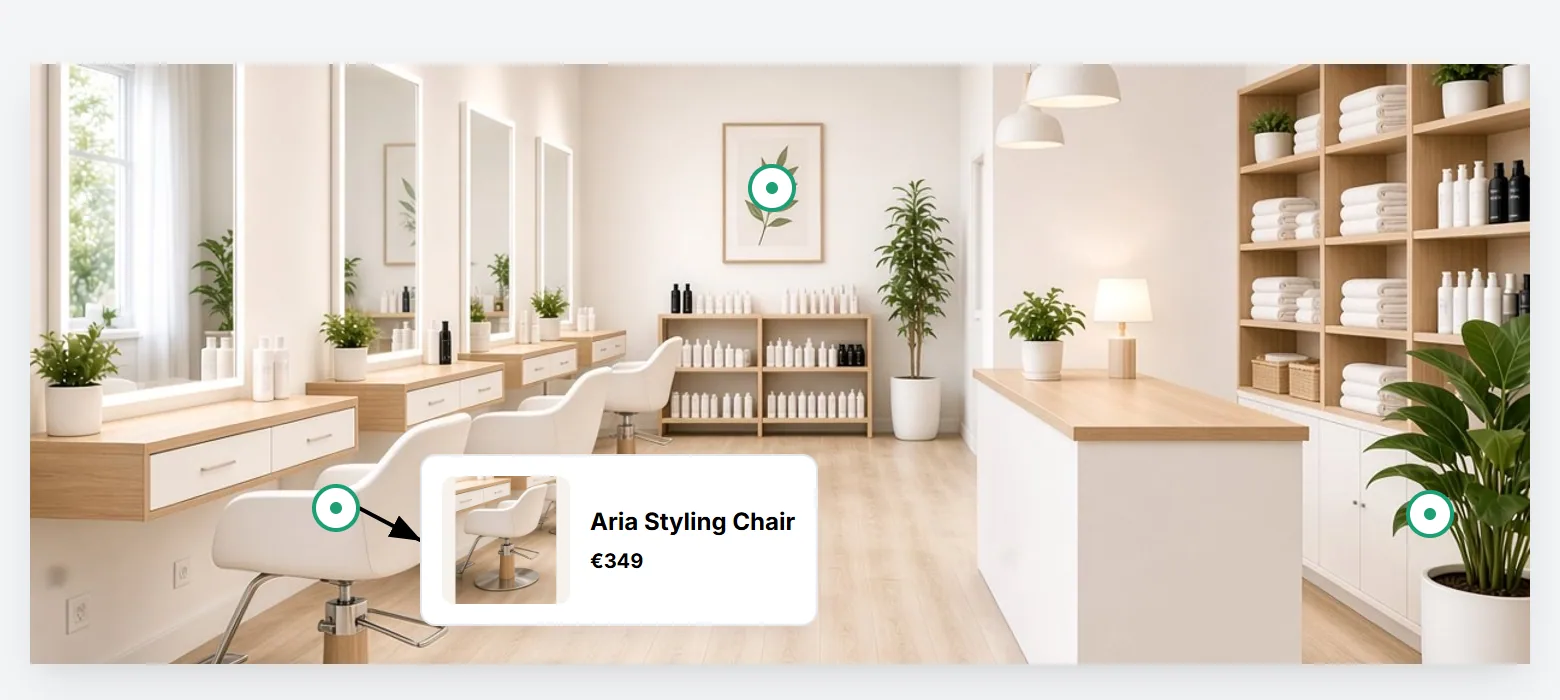
An interactive banner keeps the image but layers information on top of it. In a shoppable banner, each product in the picture has its own hotspot, tooltip and link. That brings three practical differences:
- Depth without clutter. The image stays as clean as a static one; names, prices and details appear only when someone asks for them.
- Precise destinations. Each product sends the viewer to its own page, instead of one landing page that makes them search again.
- A reason to stay. Exploring an image is a small, voluntary action. People who hover over a product are telling you what they are interested in.
The trade-offs
Interactivity isn't free. It asks for:
- More content. Every hotspot needs a product name, a price, an image and a working link — and someone has to keep them correct.
- More checking. More links mean more ways for one of them to be wrong. Every hotspot has to be tested before the ad goes live.
- Platform awareness. HTML5 creatives follow each ad server's rules for size, weight and click tracking.
Tools can take a lot of this weight — generating sizes, filling tooltips from a product feed, applying brand styles automatically — but the content itself still has to be right.
When to choose which
| Goal | Better fit |
|---|---|
| One message, broad reach, fast turnaround | Traditional |
| Several products in one placement | Interactive |
| Retail or e-commerce with product pages to send people to | Interactive |
| Brand awareness with a single key visual | Traditional |
| A catalogue or collection that changes often | Interactive, generated from product data |
Many campaigns use both: a static banner for reach, and interactive versions of the same creative where the placement and the audience reward exploration.
The bottom line
Choose a static banner when you have one thing to say. Choose an interactive banner when the picture already contains several things worth saying — and you can send each viewer to the one they care about.
Curious what that looks like in practice? Read What are interactive HTML5 banners? or try the live demo.